
How to Choose a Chess Opening Repertoire That Matches Your Playing Style
How to build a chess opening repertoire? It all depends on your level and playing style! While the Queen’s Gambit and Ruy Lopez might be the cream of the crop for elite chess players, amateur chess players should think twice before imitating model grandmaster games.
Whether you’re a beginner or a strong club player, statistics from chess opening databases consistently show that the best openings for amateurs are very different from those that work for grandmasters.
In this opening selection guide, we’ll take a look at openings through different eras of chess so you can choose a repertoire that’s most aligned to your playing style. We've also included opening database statistics to help you make informed choices!

Romantic Era Chess Openings—Ideal for Attacking Players
To find the best chess openings for attacking players, the best place to look is the most attacking period of chess history. In the 19th century, ‘Romantic era’ chess was all about aggressive gambits, rapid development, sharp tactics, and bold sacrifices to launch a mating attack as early as possible.
Legends of the Romantic era, like Adolf Anderssen, Howard Staunton, and Paul Morphy, loved openings like the King’s Gambit, the Scotch Gambit, Vienna Gambit, and the Danish Gambit—openings that are all about gaining a head start in development and hunting Black’s king right out of the gate.

The Camaratta Collection - The Botvinnik Flohr Series Chess Pieces - 4.0" King

Leap Digital Classic Chess Clock

US Chess Premium Chess Box
Trawling through chess opening explorer databases, it’s fascinating to see how Romantic era openings are some of the highest-scoring in amateur chess. Since these razor-sharp lines require extremely accurate play to avoid the manifold tactical traps, why wouldn’t they still prove lethal against unprepared opponents?
| Gambit Opening | Win Rate (%) |
|---|---|
| Boden–Kieseritzky Gambit (W) | 62 |
| Göring Gambit (W) | 60 |
| Wild Muzio Gambit (W) | 60 |
| Deutz Gambit (W) | 59 |
| Vienna Gambit (W) | 57 |
| Double Danish Gambit (W) | 57 |
| Scotch Gambit (W) | 55 |
| Evan’s Gambit (W) | 53 |
| Rousseau Gambit (B) | 51 |
| Stafford Gambit (B) | 50 |
| Elephant Gambit (B) | 48 |
| White’s Average Win Rate | 50 |
| Black’s Average Win Rate | 46 |
An Exemplar Attacking Opening: The Wild Muzio Gambit
Of all the Romantic-era chess gambits, none is more brazen and thrilling than the Wild Muzio Gambit. An offshoot of the King’s Gambit, this opening scores brilliantly even against players rated 2000+ in blitz and bullet games.
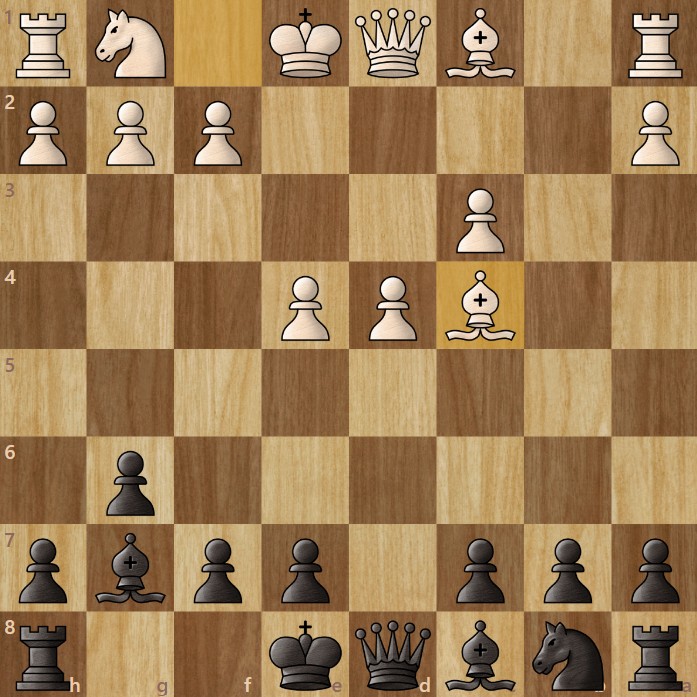
In the Wild Muzio Gambit, White sacrifices a knight and then a bishop to win a massive lead in development and a bounty of tactical opportunities. If you were in Black’s shoes now, what would you play?

If, like most players, you chose 7...fxg2, you would have just lost the game. In answer, White opens fire with 8. Qh5+. With all of its pieces still on their starting squares, Black simply has no way to defend the attack. White’s queen, rook, central pawns, and bishop will move in to quickly recover material, if not a quick checkmate.
While this is an extreme example, it’s the perfect demonstration of how a head start in development can outweigh a material deficit in the opening. If you like openings that run the razor’s edge like this, there’s a whole treasure trove of Romantic era openings that you can add to your repertoire!
Classical Era Chess Openings—Ideal for Positional Players
For quieter, positional chess players, some of the gambits that we just discussed might be your worst nightmare! If instead, you enjoy slow, patient, solid play, then there’s a very different school of openings for you to choose from.

The Collector Series Luxury Chess Pieces - 4.0" King

The Camaratta Signature Master Chess Table

LIMITED EDITION - DGT 3000 Digital Chess Clock
After the Romantic era of chess, Grandmasters like Wilhelm Steinitz and Emanuel Lasker used scientific analysis to conclude that premature attacks are ineffectual as long as there are no fundamental positional weaknesses. Thus, the Classical era (1870s to 1920s) of positional chess was born.
Positional openings for White like the Queen’s Gambit (not a true gambit at all!), the Ruy Lopez, and the Giuoco Piano dominated the classical era. Later, the London System and the Colle System would join the classical family. Black also began favoring ultra-solid defenses like the Petrov Defense, French Defense, and Caro-Kann Defense.
| Positional Opening | Win Rate % |
|---|---|
| London System (W) | 53.00% |
| Queen’s Gambit (W) | 53.00% |
| English Opening (W) | 51.00% |
| Ruy Lopez (W) | 51.00% |
| Caro-Kann Defense (B) | 49.00% |
| French Defense (B) | 48.00% |
| Petrov Defense (B) | 45.00% |
An Exemplar Positional Opening: The London System
Rock solid, flexible, unbreakable. The London System epitomized Classical era chess and was one of the most popular openings toward the end of the Classical period. It is also far easier to learn than the endless lines of complex theory of the Queen’s Gambit or Ruy Lopez.
Instead of being played in a specific move order, the London System simply aims to achieve a robust setup or ‘system’ of a pyramid of pawns with pieces placed harmoniously around them. Pawns are placed on e3, c3, and d4; knights on d2 and f3; and bishops are usually posted on d3 and f4.

The London System has a reputation for being a rather boring opening, but that may be because it is so difficult to play against! White’s position is so solid that it affords very few inroads for Black. White, on the other hand, can often create attacking maneuvers through positional weaknesses in Black’s setup. The e5 square, for example, can make a perfect outpost for the king’s knight.
More than a century after its inception, the London System remains one of the best beginner chess openings. Because you can play it almost regardless of what your opponent plays, it’s extremely easy to memorize. For those who are looking for a safe way to start a patient chess game, the London System and its cousin, the Colle System, make excellent choices.
Hypermodern Openings—Combining Position With Flow
After many decades of classical opening dogma, a new wave of revolutionary thinkers like Aron Nimzowitsch and Richard Réti began to question and replace many assumptions of classical opening theory. This breath of fresh air would become known as the Hypermodern school.

The Harrwitz Series Timeless Chess Pieces- 3.5" King

Super Deluxe Tournament Director Kit

Large Wedge Chess Clock Carrying Bag
Hypermodern theory argues that the center of the board doesn’t necessarily need to be occupied with pawns. Instead, it can be won more patiently with minor pieces and flank pawns. Hypermodern openings typically feature fianchettoed bishops and gradually ratchet up pressure on the center before a timely pawn break.
Openings like the Nimzo-Indian Defense, Grünfeld Defense, Pirc Defense, and the Réti Opening prove that chess openings can be positionally solid while retaining fluidity, sharp positions, and tactical opportunities.
Hypermodern openings offer a balanced approach that’s well suited to intermediate and advanced players who enjoy patient psychological tension as well as the thrill of tactical breakthroughs. Because hypermodern openings require in-depth understanding to play successfully, however, they’re not typically recommended for beginners.
| Hypermodern Opening | Win Rate (%) |
|---|---|
| Reti Opening (W) | 54 |
| King’s Indian Attack (W) | 53 |
| Nimzowitsch–Larsen Attack (W) | 50 |
| Benoni Defense (B) | 49 |
| Grunfeld Defense (B) | 48 |
| King’s Indian Defense (B) | 47 |
| Pirc Defense (B) | 47 |
| Nimzo-Indian Defense (B) | 46 |
An Exemplar Hypermodern Opening: The Grunfeld Defense
With its patient buildup and sudden strike at the center, the Grunfeld Defense offers the perfect illustration of hypermodern ideas. Black has purposely allowed White to occupy the center with pawns. Indeed, White’s center looks impressive, even unshakable. But Black has a cunning plan. Can you find Black’s next move to undermine the center?
1. d4 Nf6 2. c4 g6 3. Nc3 d5 4. cxd5 Nxd5 5. e4 Nxc3 6. bxc3 Bg7 7. Bc4
Answer: 7...c5! Launching the ambush, Black’s c-pawn strikes at White’s center. With the fianchetto bishop adding pressure to d4 and X-raying c3 and White’s rook, White must be extremely careful not to make any false moves. The center can open suddenly now, casting abundant tactical opportunities on the table.
As the game progresses, Black will typically ramp up pressure on d4. If it proves overwhelming, Black may come to dominate the entire long dark-squared diagonal and take a distinct upper hand. Positionally solid yet sprung with tactical potential: the hallmark of a good hypermodern opening!

The Library Collection - The Anderssen Dropjaw Series Luxury Chess Pieces - 3'' King

DOWNLOAD - FRITZ 21

Millennium eONE Electronic Chess Board for playing on chess.com
King's Pawn and Queen's Pawn Systems: 1.e4 vs 1.d4
A classic question chess players ask when choosing an opening repertoire is, "Should I choose 1. e4 or 1. d4 openings?" A simple way to think about it is tactical vs. positional openings.
In general, 1.e4 tends to produce more open, tactical games. Openings such as the King’s Gambit and Scotch Game harbor many of the most aggressive variations in chess. The Sicilian Defense also tends to produce sharp, tactical games.
1. d4 openings, by contrast, tend to produce more closed, positional games. The Queen’s Gambit and the London System are famed for being solid and leading to quieter, more positional play. But there are many exceptions to the rule!
Remember that 1. e4 can also lead to more closed, strategic openings like the Ruy Lopez, the Caro-Kann and French Defense. 1. d4 can also lead to sharp, hypermodern openings like the King’s Indian Defense and the Benoni Defense. So, while the first move is important, it doesn’t necessarily dictate the course of the game!
Conclusion: How to Build a Chess Opening Repertoire
To build a winning chess opening repertoire, it’s a great idea to look through the different periods of chess history to find a style that matches your own. Build your repertoire slowly and steadily—learning each opening thoroughly before moving on to another.
Remember, studying chess openings often makes less impact on your overall game than studying middlegames and endgames, so be sure to keep your studies in proportion! For players rated under 2000, it should be enough to learn a few openings comfortably and then spend the rest of your study time on chess strategy and tactics.
Related: The Best Opening Repertoire Books for Intermediate Players