
How to Counter the Ruy Lopez
Sophisticated, complex, and with endless variations, the Ruy Lopez is widely considered the most heavily analyzed of any opening in the book! For these reasons, it is generally not recommended for beginners.
Whatever level you are, however, you’re bound to meet the Ruy Lopez with the black pieces—so how should you counter it? In this guide, you’ll learn how to play the Jaenisch Gambit (aka Schliemann's Defense), a rarely played line that scores better than any other against amateur players.
This tricky yet sound chess opening is even sometimes brandished to conquer the world’s best chess players. Stick around to see how it has toppled titans like Capablanca and Anand!
Jaenisch Gambit Statistics
Despite being played so rarely, the Jaenisch Gambit scores significantly better than any other answer to the Ruy Lopez among amateur players. The table below shows Black’s win rates with each immediate answer to the Ruy Lopez in over 150 million online games.

Do you see the anomaly? The Jaenisch Gambit (3...f5) scores Black an astonishing 51% win rate—miles better than any other. Even at higher levels with longer time controls, statistics still suggest this is Black’s best option. Let’s find out why.
Black’s Highest Scoring Answer to the Ruy Lopez: The Jaenisch Gambit
The Jaenisch Gambit begins with the opening sequence: 1. e4 e5 2. Nf3 Nc6 3. Bb5 f5
In amateur chess, White usually chooses between three responses. Let’s take a look at them one by one.

The Library Collection - The Anderssen Dropjaw Series Luxury Chess Pieces - 3'' King

Millennium eONE Electronic Chess Board for playing on chess.com
A) White Accepts the ‘Gambit’ (4. exf5 e4)
The first thing to know about the Jaenisch Gambit is that it’s not really a genuine gambit. White should never accept Black’s offering since Black can gain a better position and, with skillful play, win the pawn back.
Just like the similar Rousseau Gambit, if White accepts the gambit, you push the e-pawn to kick White’s knight. Where will the knight move to?
1. e4 e5 2. Nf3 Nc6 3. Bb5 f5 4. exf5 e4

White now has three main options:
- 5. Ng1 – Undeveloping the knight back to g1 is obviously a concession to Black. Continue with 5...Qg5, forking White’s f5 and g2 pawns.
- 5. Qe2 – White pins the attacking pawn. Respond with 5...Qe7, undoing the pin. White’s most effective path to recovery is 6. Bxc6 dxc6 7. Nd4. Continue with 7...Qe5, double attacking White’s knight and f5 pawn. You come out in a commanding position.
- 5. Bxc6 – White decides to trade pieces on c6 with the hope of freeing the d5 square for its knight. Play usually continues 5...dxc6. 6. Ne5 Bxf5. If White allows, play 7...Qd4. Once again, your queen stands strong in the center, chasing White’s knight and threatening further attacks.
- As a recap—you don't necessarily need to memorize these lines precisely. White has already handed you an advantage! Just remember to look for queen moves that create double attacks and further threats.
Game in Focus: José Raul Capablanca vs. William Pratt, 1909
The following game demonstrates how the Jaenisch Gambit is a stellar chess opening to trip up stronger opponents. In 1909, William Pratt sprung it upon the future world champion Capablanca in a 24-board simultaneous match—and won!
Capablanca, renowned for his sparse opening knowledge in his early years, made the mistake of accepting the gambit. Just as we described above, Capablanca made the best possible recovery, yet Pratt had clearly done his homework to keep the pressure on!
1. e4 e5 2. Nf3 Nc6 3. Bb5 f5 4. exf5 e4 5. Qe2 Qe7 6. Bxc6 dxc6 7. Nd4 Qe5 8. c3 Bd6

Even though Capablanca has played perfectly to recover from his error, the position is still uncomfortable for White. Almost every piece is restricted, while Black is free to continue developing at speed. In this precarious position, Capablanca knew it was best to trade queens.

The Fischer Spassky Series Chess Pieces - 6.0" King

DOWNLOAD - CHESSBASE '26 - Premium Package

The Millennium King Competition Chess Computer
Play continued: 9. f3 exf3 10. Qxe5+ Bxe5 11. Nxf3 Bd6. While White is now safer, development remains stunted. Because Black’s pieces are so much more active, there’s no realistic way for White to save its extra pawn on f5. Instead, Capablanca castled and allowed his opponent to equalize on material with a superior position.
This example perfectly demonstrates that after accepting the gambit, it’s impossible to regain an equal position against a skilled opponent.
B) White Tries to Get Clever (4. Bxc6 dxc6 5. Nxe5 Qd4 6. Qh5+)
Moving your f-pawn so early in a chess game can be a dangerous strategy. In many positions, a queen check from the open diagonal can be fatal. Knowing this, some players with the White pieces will try to open up the queen to reach h5 with the following sequence:
1. e4 e5 2. Nf3 Nc6 3. Bb5 f5 4. Bxc6 dxc6 5. Nxe5 Qd4 6. Qh5+

In other similar positions, this would be textbook tactical play from White. After Black covers the check with 6...g6, White is hoping that 7. Nxg6 hxg6 opens up the h-file to capture the rook. In this case, however, White has overlooked that the rook is guarded by the centralized queen!
White’s queen must instead settle for the f6 pawn. Now you’re way ahead on development and can go on a quick attack to catch White unprepared.
C) White Defends the Pawn (4. d3)
According to chess engines, White’s best answer to the Jaenisch Gambit is 4. d3 – protecting e4. This tends to lead to a fairly equal position where understanding your game plan will dramatically increase your chances of winning.
Begin by exchanging pawns in the center, then developing your other knight. 4...fxe4 5. dxe4 Nf6. After this, play Bc5 and castle kingside.
For example: 1. e4 e5 2. Nf3 Nc6 3. Bb5 f5 4. d3 fxe4 5. dxe4 Nf6 6. O-O Bc5 7. Nc3 O-O
Main Game Plan: Attack f2!
If you’re familiar with playing aggressive openings like the King’s Gambit or the Vienna Gambit, you’ll understand how to use an open f-file to your advantage. The classic idea is to castle kingside, then coordinate your rook with other pieces to attack the f-file.

The *NEW* Austrian Coffeehouse Series Chess Pieces - 4.0" King

Premium Chess Box - Golden Heart

The Large Ultimate Chess Bag
In the setup shown above, with your bishop on c5 and knight on f6, your pieces are all ready to leap into a potential attack. This is especially effective if you can remove White’s guarding knight on f3. Your light-squared bishop and queenside knight can come in very useful here.
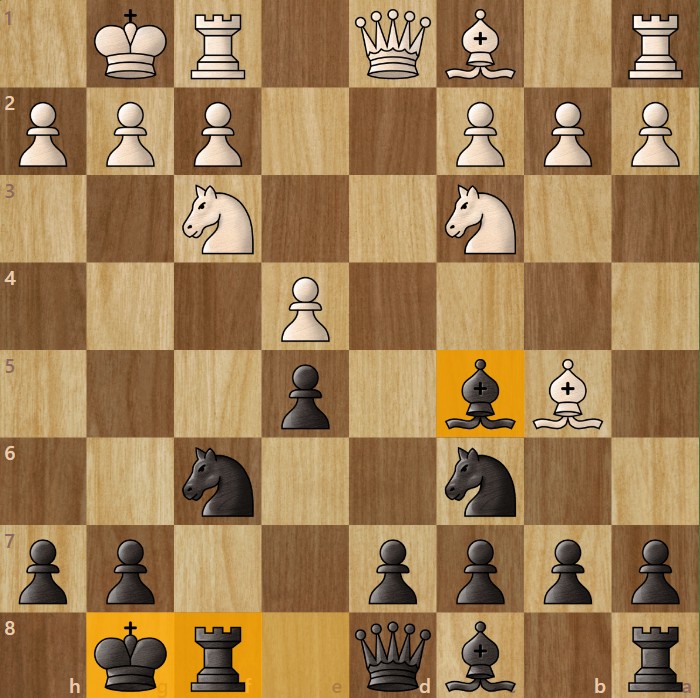
In the continuation below, how can you challenge White’s f3 knight to launch a winning attack on the f-file?

Answer: 10...Nd4! You challenge White’s f3 knight to get a cleaner attack on f2. While you could instead immediately attack f2 with 10...Ng4, it’s better to get White’s knight out of the way first and add another piece to the attack. Remember, the success of a mating attack is often determined by the number of attacking pieces involved!
Game Plan Example: Viswanathan Anand vs. Magnus Carlsen, 2008
The following game perfectly demonstrates the principle of strength in numbers when attacking the f-file. In 2008, reigning world champion Viswanathan Anand was challenged by a 17-year-old Magnus Carlsen playing the Jaenisch Gambit. The game ultimately ended in a draw, but Carlsen did manage to gain an advantage by piling pieces into an f-file attack.
It’s move 20, and Anand is struggling to find enough pieces to defend f2. His second defending rook has just been forced onto d2. Can you find Carlsen’s next brilliant move?

Answer: Be3! Carlsen attacks Anand’s crucial defending rook. Anand cannot capture it since it would hand Carlsen checkmate in two moves on f1. The rook also can’t move since it would allow Black to win f2. White’s rook is effectively trapped, and Carlsen goes ahead on material!

The Library Imperial Collector Series Luxury Chess Pieces - 3.0" King

Luxe Premium Chess Box - Amboyna Burl

The House of Staunton DELUXE Tournament Bag
This example perfectly demonstrates how persistent pressure on the f-file can lead to many other advantages besides a mating attack. The threat of crashing the f-file is so final that your opponent may have to sacrifice position and material to defend it.
Alternative Game Plan: Attack the g-file
In a high proportion of 4. d3 games, White will combine its minor pieces to pin and capture your knight on f6. Although this may weaken your kingside pawn structure, it also affords you the chance to attack the g-file—a strategy that’s surprisingly effective even at the highest level.
Game Plan Example: Viswanathan Anand vs. Vassily Ivanchuk, 2011
A few years later, Anand was up against the Jaenisch Gambit again vs. GM Vassily Ivanchuk. This time, Anand decided to use the tactic we just mentioned. Anand has just played 9. Nd5, attacking Black’s pinned knight. Black can’t prevent the knight from being captured and will be forced to recapture with its g-pawn.

While this pawn structure looks vulnerable for Black, this commonly occurring theme often hands Black an eventual advantage. After the pawn recaptures on f6, Black’s solid pawn pyramid does a good job at protecting the king from attacks from the center.
Soon after, Ivanchuk moved his rook to g8 to begin attacking on the g-file. In this game, the constant pressure on the g-file eventually gave Black the initiative. It’s a pattern seen again and again when studying the 4. d3 line.

The Guardian Series Chess Pieces - 3.75" King

Premium Chess Box - Mahogany

Chronos GX Clock Carrying Bag
Best Way to Defeat the Ruy Lopez — Our Conclusion
While the Ruy Lopez is one of the toughest openings in chess, the Jaenisch Gambit is a razor-sharp weapon to take it down. This opening is especially effective against unprepared opponents, and its efficacy against the world’s top players proves its potency at every level.
Remember, a great perk of rarer lines like this is that your opponent is unlikely to know the theory as well as you! In other words, you'll be taking them onto your home turf where you can enjoy a psychological edge. Against the likes of the Ruy Lopez, it will also save you learning a huge amount of theory!
Related:
- Secrets of the Jaenisch Gambit DVD by GM Leonid Kritz
- Guide to the Schliemann's Defense Book (aka. Jaenisch Gambit) by Eric Schiller and Leonid Shamkovich