
Your Complete Guide to Chess Puzzles
Our brains like to solve problems, and puzzles are the perfect kind. In chess, puzzles are just positions. A puzzle is when the board is set up to a certain moment where a good move is ready to be played. In a way, it’s like cutting away all the fat from a chess game and getting right to the important bit. Thats what makes chess puzzles fun! But not only are chess puzzles entertaining, but they are also excellent training tools for improving at the game.

Should Chess Players Use Chess Puzzles?
Some players don’t like doing chess puzzles because they think they are boring or a waste of time, but if you want to get better at chess, puzzles are one of the most important parts of your chess training. For beginners, they help you train and learn patterns. The same way you learn scales as a musician or practice fundamentals in a sport, training tactics through puzzles raises your ceiling as a chess player. If you want to win games, you need to train through chess puzzles.
How to Use Chess Puzzles in Your Chess Training
Okay, but how? Should you do a hundred checkmates-in-one? Pick a random chess book off your grandfather’s shelf? Or just hope that the puzzle of the day on chess.com is enough to catapult you into 2000 ELO? Any of those options would be fine, but there are a few different approaches to chess puzzles that can be useful, and even fun.

The *NEW* Austrian Coffeehouse Series Chess Pieces - 4.0" King

DGT 3000 Digital Chess Clock

The Camaratta Signature Championship Chess Table - Dark Brown
Where and How to Solve Chess Puzzles
There are hundreds of excellent chess books that offer a curated selection of chess puzzles tailored to different skill levels and preferences. I recommend Susan Polgar's book, Chess Tactics for Champions, for intermediate players or those who have already completed Everyone’s First Chess Workbook. Chess Tactics for Champions continues to categorize puzzles by tactic and pattern, allowing you to focus on specific patterns you need to practice. After finishing the forks chapter, you'll notice yourself spotting more forks in real games. But, if doing puzzles in a book is too much work for you, there are also great online resources.
Online Resources for Chess Puzzles
There has never, in all of history, been an easier time to access, immediately, endless numbers of chess puzzles online. If you want to solve puzzles, the internet is ready to help. That, though, can feel overwhelming. A good place to start, free of charge, is Lichess.org. They have a puzzles page that will introduce you to certain tactics, but that can also show you harder puzzles and gear them more towards your level. Don't be discouraged if harder puzzles take you more time. In fact, I would rather you take as much time as you need to solve a puzzle than quickly guess in order to see the right move. Chess improvement takes time, and calculation is your brain doing the work it needs to do to get better.
Different Ways to Solve Puzzles Online
Lichess will be my example here, but there are similar methods on Chess.com as well, though not all of its features are free. But if you have an account, I enjoy their leveling-up system for completing puzzles. They have gamified the completion of chess puzzles in a really enjoyable way.

The Burnt Dubrovnik Series Chess Pieces - 3.75" King

DGT 2500 Digital Chess Clock

Premium Chess Box - Brazilian Rosewood
General Puzzles
If you just click the Lichess puzzle page and you are signed in, it will give you a puzzle tailored to your level. This is basically an ELO, or rating, that helps track your puzzle improvement, but also gives you puzzles that are around your skill level. This is a great way to get a variety of puzzles at a good difficulty for you.
Puzzle Themes
You can also solve puzzles by theme! This means that you pick one type of puzzle to focus on, and it gives you just that kind of tactic or position. Drilling down on specific tactics can be a good way to train your brain to recognize those tactics in your actual games. If you notice you are often losing to forks or pins, training those puzzles can also help you avoid getting caught in those tactics.
Puzzle Streak or Puzzle Storm
Puzzle streak is a way to solve puzzles, where it gives you easier puzzles at first, and you try to solve as many as you can as they get more and more difficult. This is great because it doesn’t just give you one kind of puzzle, and you can stretch your calculation skills as you get farther along. Puzzle Storm, though, is a timed game where you try to solve as many as you can in a certain amount of time. On chess.com, this is also called Puzzle Rush, and it is a good way to gauge your improvement by following your score and trying to beat your past scores.
How a Beginner Benefits From Learning Patterns
If you are new to chess, why are chess puzzles so important? Learning puzzles trains your brain to recognize patterns. The difference between winning and losing a game is very often just whether or not you notice a simple fork or pin. Those tactics can completely swing games, so being familiar with the patterns will help you win games. Puzzles can also teach you strategy and endgames.
Puzzle Types and What They Teach
- Tactics:
When you think of chess puzzles, you tend to think of forks, pins, skewers, and discovered attacks. This is definitely a major part of chess puzzles, and practicing these will help you recognize these tactics in games in a way that can change the outcome and earn you ELO points. But there are other types of chess puzzles as well. Studying more complex positions for extended periods of time can help you learn chess strategy.
- Strategy:
Some chess puzzles emphasize positional sacrifices or the enhancement of piece activity. While many strategy books feature puzzles that teach you to recognize these moves, such puzzles are less frequently found in typical chess puzzle collections or online resources.
- Endgame puzzles:
Using chess puzzles is an excellent way to enhance technique and precision under endgame pressure. Calculation becomes crucial in complex endgames when physical movement and marking arrows are not possible during a real game. Therefore, practicing fundamental endgame positions through puzzles can be very beneficial. Most puzzle books or websites include an endgame section, and practicing these positions can increase your chances of winning and boost your confidence to steer a game into a winning endgame.

The W.T. Pinney Series Chess Pieces - The Camaratta Collection - 4.75" King

Tap N Set Pro Digital Chess Clock - with DOUBLE DISPLAYS

Signature Fitted Coffer Chess Box - Walnut Burl
Tracking Your Chess Improvement Through Puzzles
As you incorporate chess puzzles into your training plan, you'll notice they are an excellent way to monitor your progress. Not only can you track your online puzzle rating improvements, but also your speed in solving them. After practicing puzzles for several weeks, you'll observe how much quicker you become at recognizing patterns. As you learn more puzzle types and patterns, both your online and over-the-board (OTB) ratings are likely to improve through regular practice. I recommend not fixating too much on your puzzle ratings on sites like chess.com or Lichess. Instead, focus on the time spent solving puzzles or the total number completed.
How to Solve Chess Puzzles
If you're struggling to find the right answer to chess puzzles or feel lost at the start, here are some tips to help you identify the correct move or where to look. First, avoid common mistakes: don't move too quickly or settle for the first move that comes to mind. If unsure, take time to calculate; this will help your improvement. Also, try to determine the theme or purpose of the puzzle by focusing on the best move, which can reveal patterns. For example, immediately assuming it's a fork puzzle might cause you to overlook a checkmate in one. When playing a real game, always aim for the best move by examining your forcing moves.
Forcing Moves to Win: Checks, Captures, Threats!
The first step in solving a chess puzzle is to analyze checks, captures, and threats. Focusing on forcing moves reduces your options and simplifies calculations, guiding you to identify the best moves. This skill is crucial in chess, helping you avoid serious errors and spot checkmates.

The Library Collection - The Anderssen Dropjaw Series Luxury Chess Pieces - 3'' King

Millennium eONE Electronic Chess Board for playing on chess.com
Checks
The check is the most forceful move in chess, demanding an immediate response from your opponent to escape danger. Many chess tactics revolve around checks, underscoring the importance of safeguarding your king and the opponent's king. If you could recognize all possible checks in any situation, I guarantee your chess rating would improve dramatically.
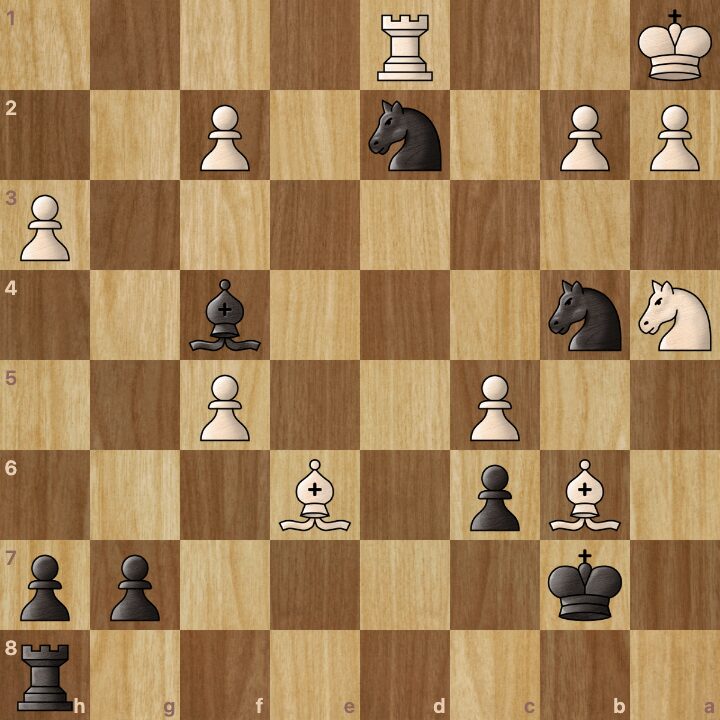
In this position, if Black fails to check their checks, they will miss a win!
Captures
If you haven’t seen any checks that work, you should scan the position for captures. When you capture an opponent's piece, you force them to decide whether to allow you to keep the material gained or to recapture. They must make that decision, or else they will lose material.
Threats
When we make a threat to our opponent, they must respond or face the consequences of that threat. If we make a threat of checkmate, our opponent does not have the time or tempo needed to do anything else except deal with that threat. That means that we can use threats as forcing moves to find good tactics. If you don’t spot a check or capture that leads to a tactic, make sure you also examine the threats.
Frequently Asked Questions
These days, chess puzzles can easily be found online. I recommend Lichess.org for free puzzles, or chesstempo.com as well. Those are great free online resources for chess puzzles.
There are so many chess puzzle books that there is no single best one. However, I recommend Susan Polgar's book, Chess Tactics for Champions, for intermediate players.
Chess puzzles often cover different tactics, but they can also lead to strategically advantageous positions or winning endgames.
I recommend spending most of your time playing chess, but if you are new to the game, spending 20 to 40 percent of your study time drilling puzzles will help you improve.
Don't worry too much if a puzzle takes you a long time. That means your brain is taking the time to learn! But if a puzzle takes you more time than you have available, then that might be a sign that it is currently out of your skill range.