
The King’s Pawn Opening: A Complete Guide
The King’s Pawn Opening (1. e4) is White’s most common way to start a chess game. But what makes it so popular, and is it, as Bobby Fischer once said, "the best by test"?
In this article, we’re going to explore the most famous continuations of the King’s Pawn Opening and reveal the statistically highest scoring chess openings it leads to when playing with the Black and White pieces. There are plenty of surprises in store, including some of the most deadly openings you've never heard of!

The King’s Pawn Opening With the White Pieces
In today’s chess, the King’s Pawn Opening reigns as White’s most popular opening. Seen in 60% of amateur games and 46% of modern master games, it’s played significantly more than 1. d4, the Queen’s Pawn Opening at all levels.
By moving the king’s pawn two squares forward, 1. e4 immediately does four things:
- Controls key central squares d5 and f5.
- Prevents enemy pawns from reaching e4.
- Opens up a diagonal for the light-squared bishop to develop.
- Opens up a diagonal for the queen to develop.

As a versatile opening move, 1. e4 leads to many of chess’s most famed openings. In this guide, we’re going to look at several of them, including their statistical performance among amateur players.
The King’s Pawn Openings for White—a Statistical Analysis
The birth of online chess databases has allowed us to trawl through billions of online games to discover which openings score best at every level. The insights have been incredibly revealing.


While classical chess theory tends to revolve around the openings that perform well for grandmasters, the same openings often don’t score very well for amateur players (and vice versa). The study of openings for amateurs can, therefore, be regarded as distinct from opening theory of master players.
Looking at the most common continuation of the King’s Pawn Opening, the table below shows us the win rates of different moves following 1. e4 e5 2. Nf3 Nc6 on lichess.org. Players were rated between 400 and 2200 Elo.

We see from the table that most of White’s next moves, like 3. Bc4 (the Italian Game) and 3. Bb5 (the Ruy Lopez), score White roughly a 50% win rate. The best continuation at this level, however, is revealed to be 3. d4—the Scotch Game with a 53% win rate for White.
Using these tools, we can determine which chess openings have the best chance of winning at our level of play. We’ll be referencing these win rates when assessing the openings below.
The King’s Gambit (1. e4 e5 2. f4)
Few chess players realize it, but the King’s Gambit is one of the most successful openings for beginner and intermediate players. It scores a 54% win rate among players rated 1000-1600. With its fast-paced attacks and easy-to-understand game plans, the King’s Gambit is ideal for novice chess players looking for an exciting game.

By sacrificing its f-pawn, White can claim central dominance and launch a ferocious attack down the semi-open f-file after kingside castling. With a bishop, knight, rook, and queen all joining the attack, White can often succeed in overwhelming Black’s defenses in an exciting middlegame mating attack!


The Italian Game (1. e4 e5 2. Nf3 Nc6 3. Bc4)
The Italian Game is a classic continuation of the King’s Pawn Opening and is perfectly suited to beginners as it is for advanced players. By playing 3. Bc4, White places its bishop on an influential diagonal, taking aim at f7.
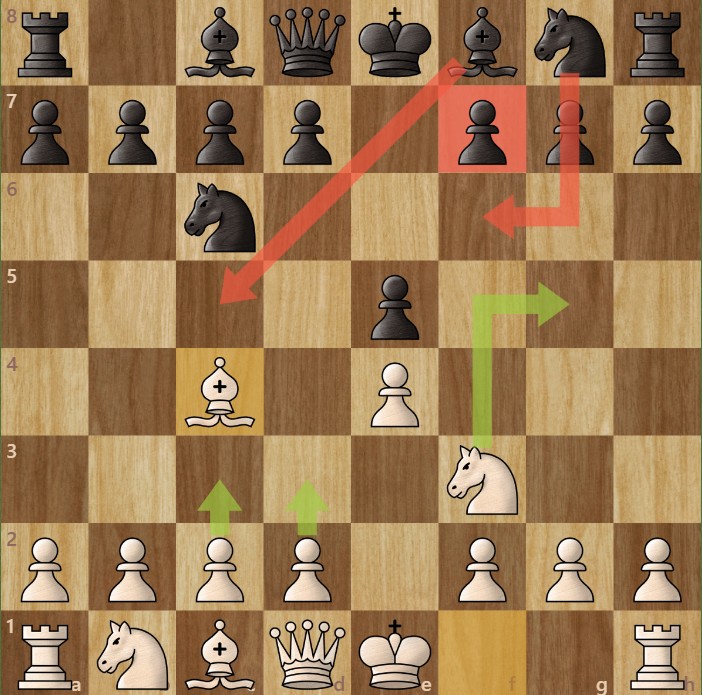
In the majority of games, Black will either respond with 3…Nf6 (Two Knights Defense) or 3...Bc5 (Giuco Piano). A notorious continuation of the Two Knights Defense is the Fried Liver Attack (4. Ng5), threatening a fork on f7. With plenty of tricks and traps in store, the Fried Liver Attack is one of the most fun and successful of all beginner openings!
The Scotch Game
The Scotch Game, or ‘Scotch Opening,’ is statistically one of White’s most successful continuations of the King’s Pawn Opening. By playing an early pawn break, 3. d4, White wastes no time in cracking open the center of the board. Black will almost always respond by capturing (3...exd4).
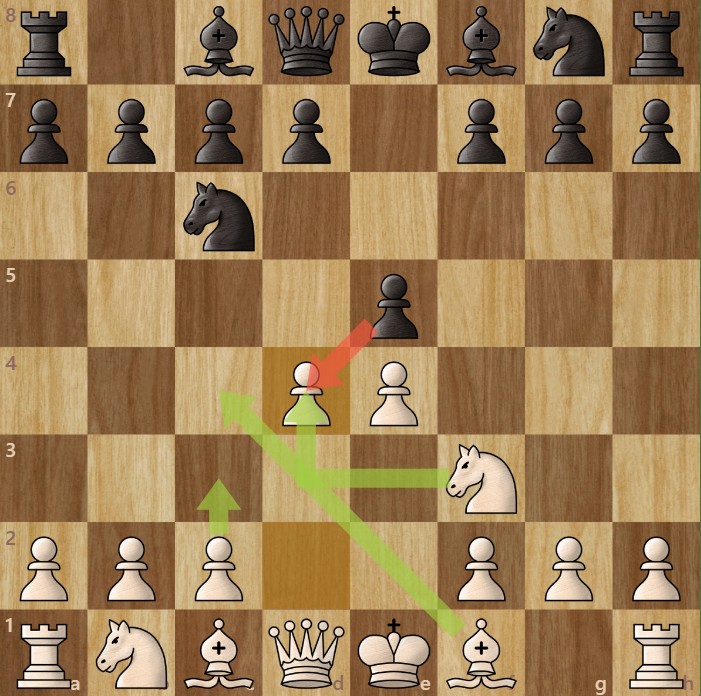
White can now either continue by recapturing the pawn (4. Nxd4) or by gambiting it with either 4. Bc4 (the Scotch Gambit) or 4. c3 (the Goring Gambit). These two gambits are both super aggressive and statistically superior ways for White to gain a crushing attack early on. Highly recommended for players of all levels!
The Ruy Lopez (1. e4 e5 2. Nf3 Nc6 3. Bb5)
The heavyweight Ruy Lopez, or Spanish Game, is one of the most famous openings in chess. By playing 3. Bb5, White threatens Black’s knight and makes its e5 pawn more vulnerable. Black’s main responses are either 3...a6, kicking the bishop away, or 3...Nf6, attacking White’s e4 pawn.
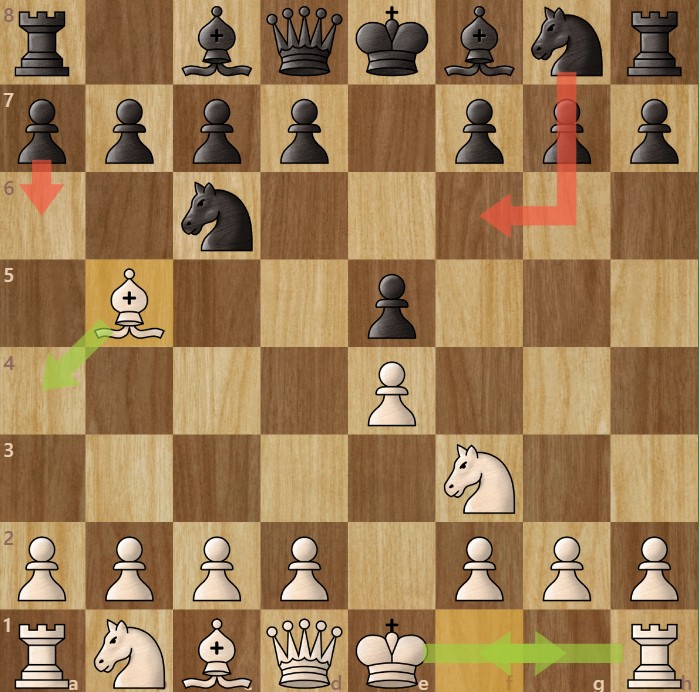
The underlying narrative of the Ruy Lopez, however, is not as simple as it first appears. As one of the most complex openings in chess, this is a favorite among grandmasters, yet there are better choices for beginners and intermediate players.
Often leading to slow, sticky games, the Ruy Lopez embodies sophisticated chess strategy and results in a whopping 55% of draws among FIDE master players!


The Vienna Game (1. e4 e5 2. Nc3)
In around 60% of amateur games, White continues the Symmetrical King’s Pawn Opening (1. e4 e5) with 2. Nf3. In the Vienna Game, however, White develops the queen’s knight first (2. Nc3). Why? One reason is that it leaves the f-file open for a pawn advance, similar to the King’s Gambit.
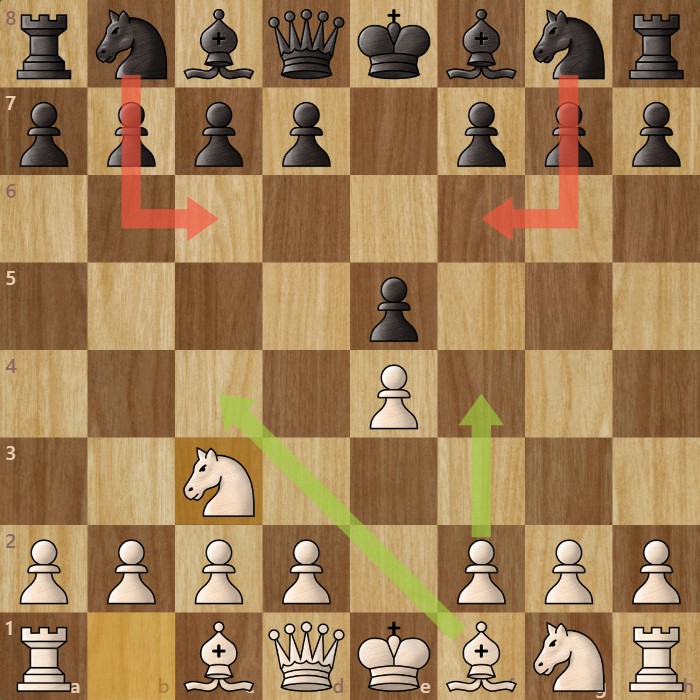
In most games, Black replies either with 2...Nc6 or 2...Nf6. Against either of these, White can launch into the venomous Vienna Gambit with 3. f4. Just like with the King’s Gambit, an intrepid attack on the kingside often follows. This is another brilliant chess opening for adventurous beginner and intermediate players who love the thrill of fast, tactical attacks from the get-go.
The King’s Pawn Opening With the Black Pieces
Against the King’s Pawn Opening, Black has many strong ways to answer. Let's look at some stats to see how they perform.
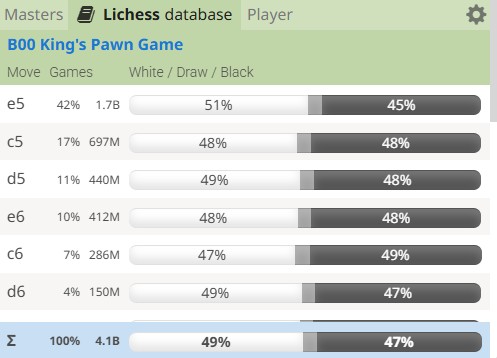
Interestingly, the table shows that Black’s most common response, 1. e5—the Symmetrical King’s Pawn Opening, is far from the most successful! This is likely because it allows White to play their favorite continuation—one that they’re likely to know better than their opponent!
All other common responses—the Sicilian Defense (1...c5), Scandinavian Defense (1...d5), French Defense (1...e6), and Caro-Kann Defense (1...c6)—all score significantly better for Black. Let’s take a closer look at each of them.
The Sicilian Defense (1. e4 c5)
The Sicilian Defense is the second most popular response to e4 among amateur players and by far the most popular among masters. An aggressive answer to the King’s Pawn Opening, Black’s c5 pawn opens up the queenside and prevents White from occupying d4 without a fight.

As one of the most complex and analyzed of all chess openings, the Sicilian creates unbalanced, sharp positions where each side may attack each other on opposite sides of the board. The game plans that follow are often very difficult to understand, and novice chess players are well-advised to steer clear of complex variations such as the Najdorf or Dragon Variations.
On the other hand, there are lines such as the Kan Sicilian, especially the tricky Kveinis Variation, that are easier to understand. Since these score well in amateur chess (≈55%), they can make a good fit for adventurous intermediate players.
The Scandinavian Defense (1. e4 d5)
Black’s third-favorite reply to 1. e4 among amateur players is 1...d5, the Scandinavian Defense. By challenging White’s center from the first move, the Scandinavian is a defiant opening that forces White to abandon their usual plans. White usually captures the pawn but by doing so loses their own central pawn.
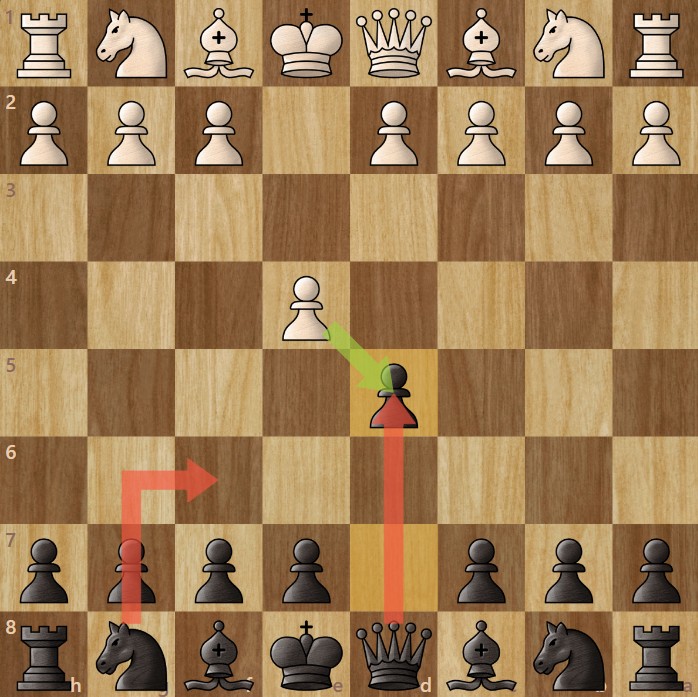
After 2. exd5, Black usually chooses the main line and recaptures with the queen (2...Qxd5). This, however, foregoes a classic opening principle: don’t centralize the queen too early! Instead, Black may choose the Modern Variation (2…Nf6) and try to recapture with its knight instead.
The Modern Variation is an easy-to-understand opening that scores extremely well against unprepared opponents. Highly recommended for beginners and intermediate players.


The French Defense (1. e4 e6)
The French Defense is a classic counter to the King’s Pawn Opening that has remained popular among amateur players and grandmasters for centuries. By answering with 1. e6, Black prepares to play 2...d5 on its next move to challenge White’s center. In reply, White usually answers 2. d4.
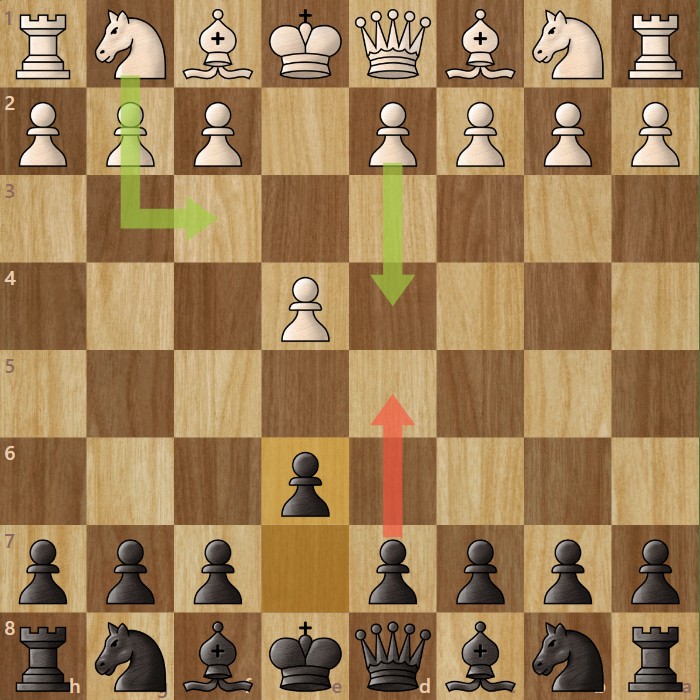
After 2. d4 d5, White has three main options: 1) Push the king’s pawn, 2) Exchange the king’s pawn, and 3) Defend the king’s pawn with 3. Nc3. Since all of these three lines harbor further variations, the French Defense is relatively theory-heavy and requires careful study to play properly.
Another potential weakness is the ‘French bishop.’ By playing 1...e6, Black blocks the natural development of the light-squared bishop. Consequently, the game can become rather cramped for Black. Nevertheless, with skilled counterplay, experienced players can turn the French into one of the most effective answers to 1. e4 in the book.
The Caro-Kann Defense (1. e4 c6)
The Caro-Kann Defense carries a similar premise to the French Defense: begin with a supporting pawn, then challenge White’s king pawn with 2...d5. Just like in the French Defense, White usually responds with 2. d4 before either pushing, exchanging, or defending its king’s pawn.

Unlike the French Defense, the Caro-Kann doesn’t block in the light-squared bishop. Instead, however, the c6 pawn can hamper the natural development of the queen’s knight. In general, it is a simpler opening than the French Defense and quite suitable for beginners and intermediate players to learn.
With a win rate of 49%, the Caro-Kann is also the single most successful immediate answer to the King’s Pawn Opening in amateur chess!
The King’s Pawn Opening—Our Conclusion
The King’s Pawn Opening is the most popular opening in chess for good reason. It’s a versatile starting move that can lead to chess’s most exciting forays, such as the King’s Gambit and Fried Liver Attack, as well as the more sophisticated, positional lines like the Ruy Lopez and Najdorf Sicilian.
Whether you’re playing with the white or black pieces, the secret to the King’s Pawn Opening is to choose the continuations that suit your playing level and style of play. This way, you have the best chance of directing the game into your favorite territory, where you can have lots of fun, beef up your middlegame plans, and hopefully win more games!
King’s Pawn Opening FAQs
The best opening following the King’s Pawn Opening (1. e4) depends on your level and style of play. While the Ruy Lopez is the grandmaster’s favorite, amateur players are better advised to choose aggressive gambits like the King’s Gambit or Danish Gambit. These are statistically proven to work better for players rated under 2000 Elo.
At the amateur level, the deadliest chess openings tend to be those with tricky gambits that force the opponent to play extremely accurately—one false move will often lose the game! Some of the highest-scoring for White include the Danish Gambit, Muzio Gambit, and Vienna Gambit. For Black, the Benko Gambit and Rousseau Gambit score exceptionally well.
There are several strong ways to respond to the King’s Pawn Opening. Among amateur players, the statistically strongest response is 1...c6, the Caro-Kann Defense. The Scandinavian Defense Modern Variation and the Sicilian Defense Kveinis Variation also score extremely well.