
The Ultimate Guide to The Queen Chess Piece
Like every piece on a chessboard, the queen has unique movement and history and is a crucial part of chess strategy. It moves freely across the 64 squares of a chessboard, controlling files, ranks, and diagonals. The most powerful chess piece, losing your queen is often as good as losing the game, but sometimes it needs to be sacrificed to win.
In this guide, we will cover everything from the queen’s origins to how to use it strategically. Read on for everything you need to know about the queen chess piece.

Brief History of the Queen
Unlike many chess pieces, the queen didn’t take on its modern character, name, and movement until around the 15th Century. The earliest form of the queen, in 7th-century India, was a viser, or minister. This consultant to the king could move a paltry one square diagonally. Later, after the game had spread to Persia, the piece evolved to be able to jump two squares diagonally on its first move.
The queen, as we know her, emerges in medieval Europe. Here, where monarchies had supreme power, the piece was given the combined abilities of the rook and the bishop. This version of the game spread rapidly and became the one we know today.
Some historians cite specific women as inspiring the rise of the queen, from Isabella I of Castile to the Virgin Mary. Whatever the case, it was the female monarch that became the emblem of power and influence on a chessboard.

The W.T. Pinney Series Chess Pieces - The Camaratta Collection - 4.75" King

The House of Staunton DELUXE Tournament Bag

Premium Chess Box - Bubinga Burl
Queen Moves, Rules, and Value
The queen is the most powerful piece on the board because of its movement. It can move any number of squares along ranks, files, and diagonals. In a way, it contains the movement of all other pieces on the board, excluding the knight, which can turn corners and jump over pieces.
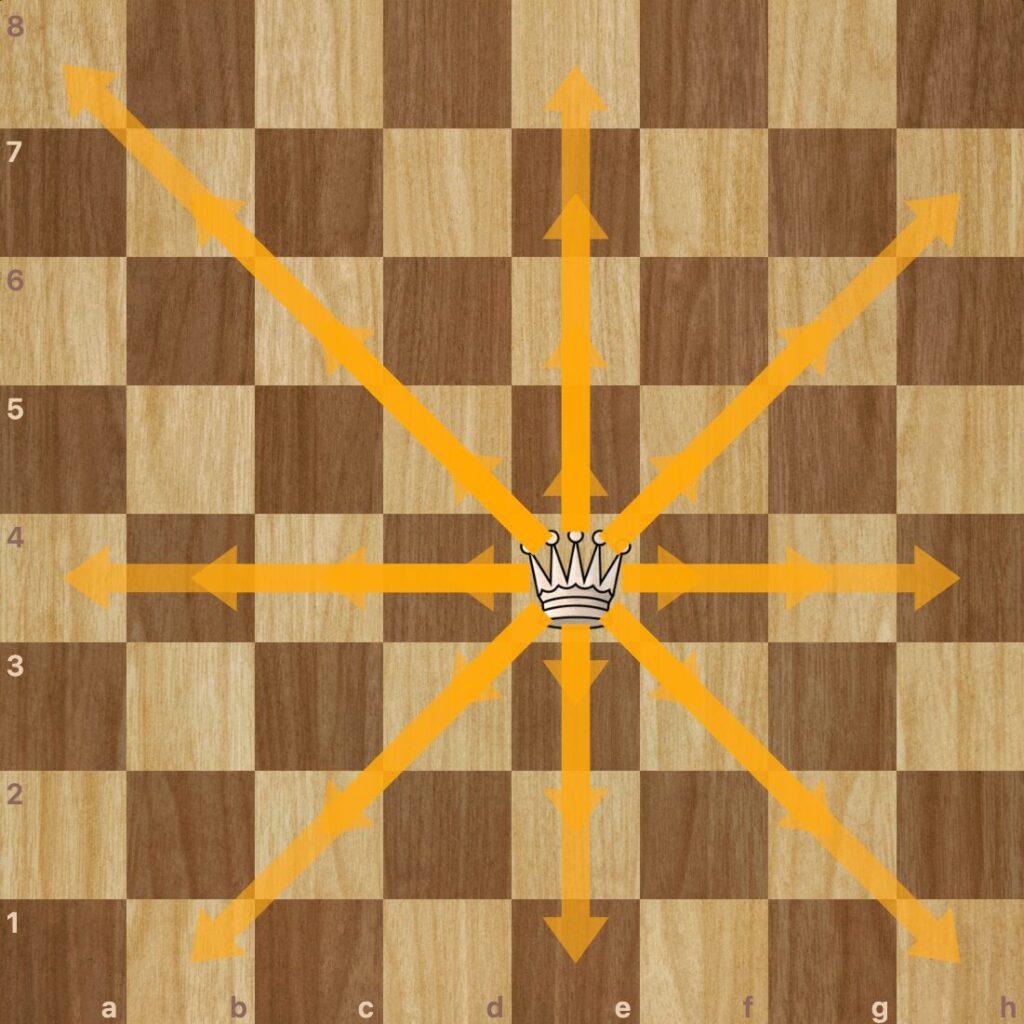
The queen does not have special moves like castling, but it is often the goal of pawns in the endgame. The usual choice for pawn promotion is the queen. As such, a chess game can feature multiple queens of the same color, and theoretically, a player could have as many as nine queens on the board.
In the piece ranking system, the queen has the highest value of 9 points. This means it is worth about as much as 9 pawns, 3 knights or bishops (worth 3 each), and slightly less than 2 rooks (worth 5 each). This last point is important to remember, as practically two rooks often outmatch a single queen in an endgame.
Using Your Queen Strategically
The queen is the most powerful piece on the board. However, this does not make her immune. If anything, queens are especially vulnerable to threats and traps. Here, we will explore the best ways to use this powerful piece to win games.
When to Develop Your Queen
For beginners, it is tempting to move the queen early. The queen’s extreme mobility and power make it seem like an easy, ideal choice for controlling the board in the opening. However, this is often a mistake.
If you move the queen to squares where it can be threatened, you may allow your opponent to threaten your queen, while also developing their pieces. Developing with threats provides tempo for your opponent. In other words, you give them more moves while you have to move your queen around to avoid it being captured.
Instead of early queen development, focus on developing knights and bishops, controlling the center with pawns, and castling. After the pieces fight for the center, the king is safe and the rooks are out, the last stage of development often involves moving the queen.

In this position, you can see that the game is quite far advanced, but both queens are on their starting squares. This is common in many openings.
Exceptions to the Rule
As is so often the case in chess, there are plenty of times when breaking the rules works well. Many legitimate openings involve developing the queen in the first few moves.
The Scandinavian Defense is an example played by everyone, from beginners to grandmasters. It starts:
1. e4 d5
2. exd5 Qxd5
3. Nc3
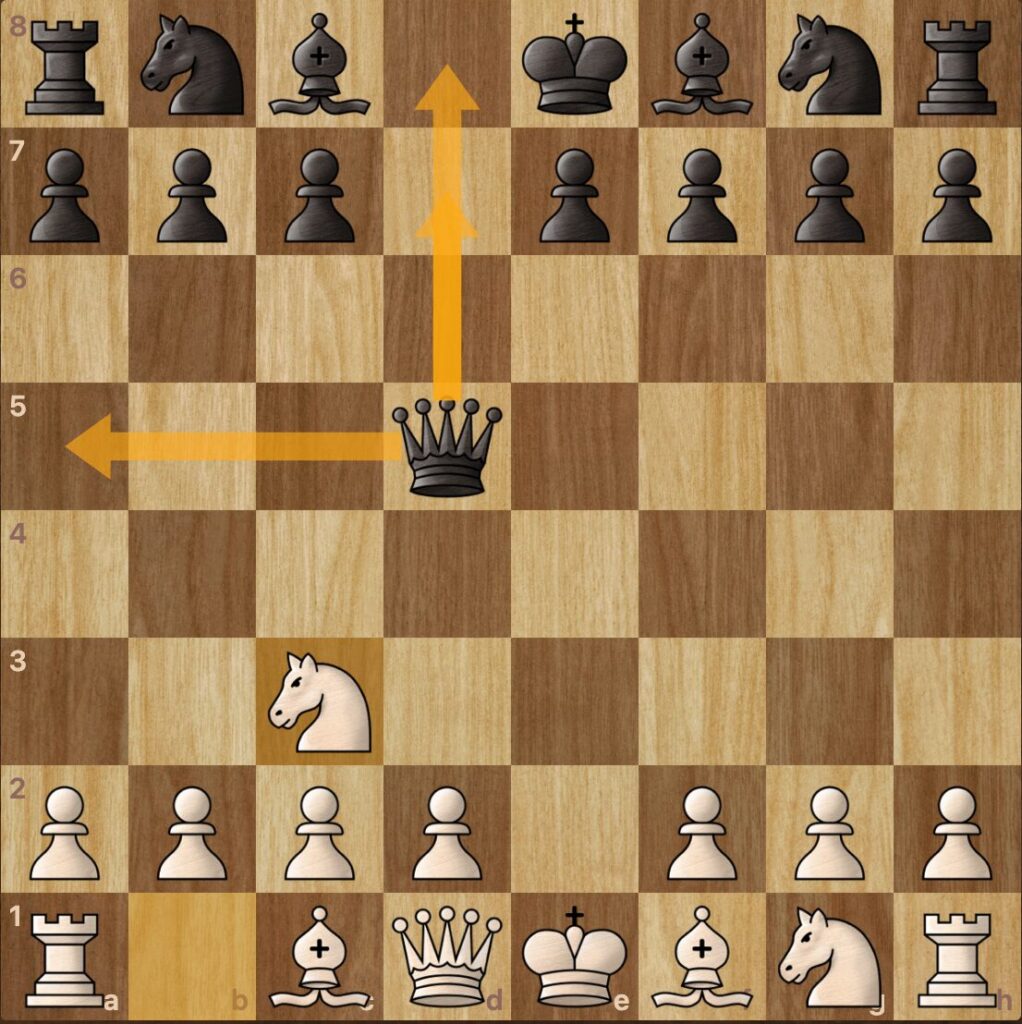
Why does it work? The queen can retreat to safe squares if necessary, and Black can develop a strong pawn structure. Often, the opening will develop into an approximately equal position like this.

Note how, if threatened, the queen can return to d5, and that attacking the queen is not especially useful for White here.
Coordinating Your Queen With Your Pieces
The queen becomes more deadly when harmonizing with other pieces.
Batteries
Creating batteries with bishops and rooks is a powerful tactic to attack underprotected squares.

For example, in this position, White can win a piece because of the checkmate threat created by the battery of the queen and bishop. White can capture the knight (Bxf6), and Black cannot recapture because of the checkmate threat.
Queens can also form batteries with rooks to control files and create threats. A famous example is Alekhine’s Gun, in which a queen forms a battery with two rooks to create huge pressure and overload a square.

This is the original position from the game between Alexander Alekhine and Aron Nimzowitsch. You can see that the triple battery creates immense pressure on the c file.

The Burnt Zagreb '59 Series Chess Pieces - 3.875" King

Leap Digital Classic Chess Clock

Understanding Before Moving 3: Sicilian Structures Part 3
Queen and Knight Coordination
The queen can also coordinate powerfully with the knight to create various kinds of threats. Often, the coordination of queens and knights can threaten the castled king.

In this example, the queen is preparing to attack the castled king with the support of the knight. To do this, White can actually sacrifice the rook here with Rxf6. If Black tries to recapture either with the pawn or the queen, White quickly has checkmate or a winning advantage following Qxh7+.
Note that creating threats with the queen often involves multiple pieces. Queens are strong, but to win, they must be used with a series of well-positioned pieces.
Queen and King Coordination
In simplified positions, the queen must often coordinate with the king to deliver checkmate. The most common example is delivering checkmate with just a king and queen, as here.

In slightly more complex positions, the king is still often used to cut off escape squares, as seen here.

When to Trade Your Queen
Knowing when to trade material is a tricky part of chess, and this is especially true with the queen. Helpfully, there are a few scenarios when it is often wise to trade or not trade your queen. Note that there are exceptions, and it always depends on the specifics of the position.
- Trade when you are up materially. If you are up a piece or a few pawns, trading your queen will take you one step closer to a winning endgame.
- Conversely, do not trade if you have a positional or tactical advantage rather than a material one. Your goal will often be to find a checkmate or win material through tactical or positional pressure, and to create this, you often need your queen.
- Trade queens if your king is vulnerable or you have lost castling rights. It is much easier for your opponent to checkmate you if the queens are on the board. So, if your main issue is king safety, getting the queens off the board is often advantageous.
- Trade your queen if your opponent’s is more active. Pieces are only as valuable as their possible moves. As a general rule, you should try to trade off your opponent’s more active pieces. This holds true with the queen. If your opponent is creating major threats with their queen, and it is not clear how yours can be mobilized, consider creating a favorable trade.
When to Sacrifice Your Queen
The most dramatic and satisfying move in chess is the queen sacrifice. Giving up your most valuable piece at the right moment often signals impressive calculation, board awareness, and daring. But when should you sacrifice your queen?
Compensation
There are times when sacrificing, or more accurately, exchanging your queen for several pieces, will actually give you a material advantage and win you the game. Here, it can be helpful to consider pieces' values, but more importantly, you need to consider whether the position is advantageous once the combination is complete.

In this position, one of the simplest ways to convert White’s material advantage is to trade the queen for two rooks. Black’s queen is on a bad square, and the rooks and bishops are poised to menace the king on the back rank.
Tactics
The classic queen sacrifice is a tactical one that provides an immediate winning advantage. This means giving up the queen to allow for a specific series of moves that wins you the game.
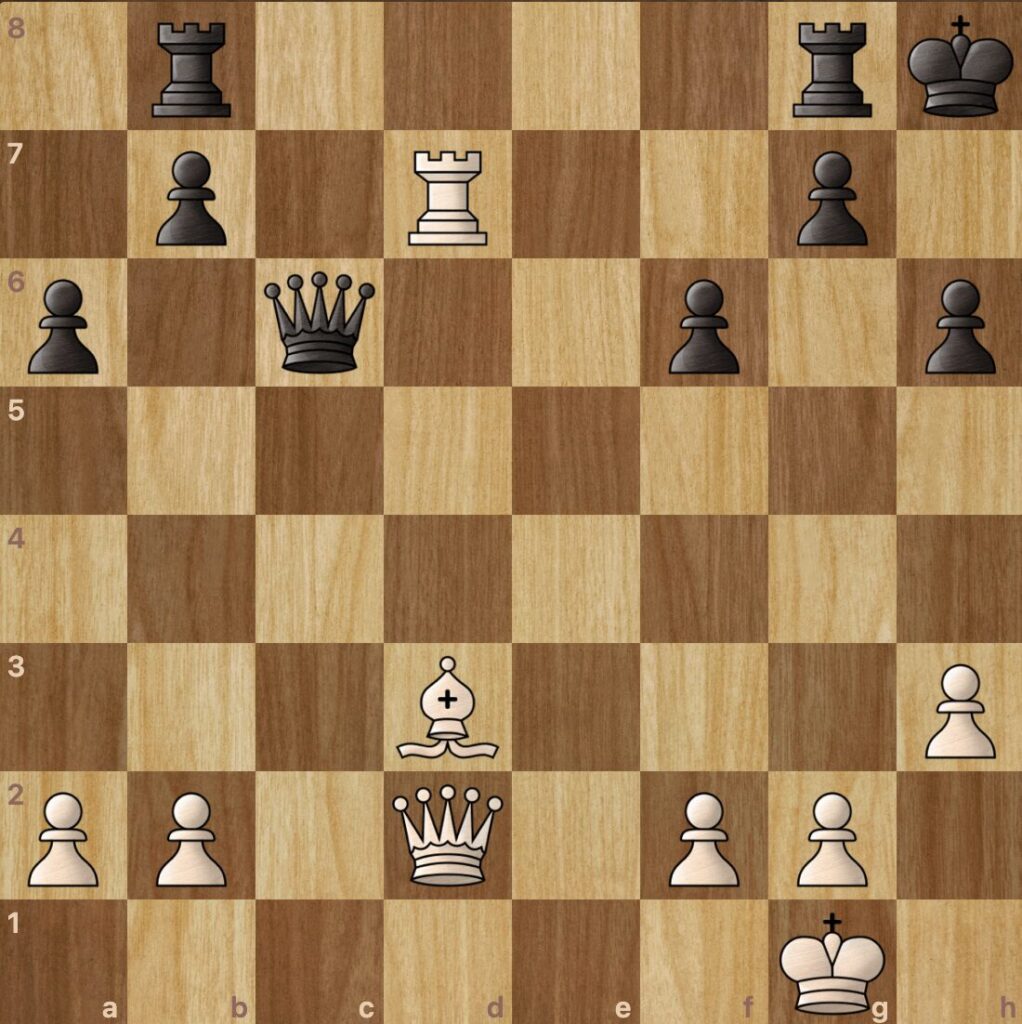
For example, in this position, white's winning move is to sacrifice the queen on h6. Black must recapture, and White delivers checkmate: Rh7#.

The Collector II Series Luxury Chess Pieces - 4.0" King

The Camaratta Signature Master Chess Table

DGT Pegasus Chess Board (e-Board) - Wireless Bluetooth with USB Charger
Major Positional Advantage
Perhaps the most advanced form of the queen sacrifice is the positional one. It provides no immediate win and comes with a loss of material. What is the benefit? In the positional queen sacrifice, you give up your most powerful pieces to create a position in which your other pieces are much better coordinated and placed than your opponent’s. Ideally, you do this with unstoppable threats, as in the following example.

In this grandmaster game, the queen is given up without a clear tactical win and no material advantage. However, the battery of rooks and pawns on a3 poses a threat that White cannot stop.
Conclusion: Queen Collaboration
The tendency of beginners to think of the queen as an independent warrior, hopping around the board collecting pieces, and eventually delivering checkmate. Actually, the queen is only truly effective when she works together with her supporting cast.
This is a key reminder in chess that pieces are only as valuable as their role in given positions. To see this in action, check out a few more classic queen sacrifices and see that the activity of your pieces and the specifics of the position are all that matter.
Frequently Asked Questions
Together, a rook and a bishop are valued at 8 points of material, and a queen is valued at 9. In most scenarios, a queen would be more valuable than these two pieces, but it depends on the position.
Pawn promotion is a key rule in chess that shapes the endgame. The queen is the most common choice because it is the most powerful piece, but there are many scenarios when underpromoting is correct for the position.
A queen sac is a shortening of queen sacrifice in which a player purposefully gives up the piece for another kind of advantage.