
Eight Facts About the Staunton Chess Set
The undisputed gold standard of chess sets is the time-tested Staunton design. Its ubiquitous lines are unmistakable, appearing in the least expensive plastic sets and the highest quality luxury sets. The set is more than just the sum of its pieces, however. Read on to learn something you didn’t know about the most popular chess set design in the world.
1. The Staunton Chessmen and the Northern Upright Design
In the Regency and Victorian Eras, drawing room chess sets were often quite delicate and tall. The Barleycorn design is one example. Several intricately turned segments made up the finished chess pieces. The aesthetic was a high slender profile with elaborate ornamentation. This made the pieces both expensive and breakable, relegating chess to more genteel spaces. The Northern Upright design was not a complete departure from its predecessors, but it was a drastic simplification.
While these pieces still had both turned and carved elements, the heavier, flared base and simple body must have inspired the design of the Staunton. The Northern Upright was popular as well, selling throughout the 1800s. All good design borrows the best elements of its predecessors, right?


2. Designer? One (or More) of These Guys
While Howard Staunton’s name was on the chess set, there isn’t broad agreement on who designed it. Nathaniel Cooke registered the design. He was a publisher who likely had family ties to the manufacturer, John Jaques (of Jaques of London). Jaques of London was already an established sporting goods company, selling a wide range of items, including chess sets. Howard Staunton was the “World Champion” at the time, though there was not a standardized way to determine who was number one. It’s highly likely he had input into the new “player forward” design. No partnership agreement between the men survived. So who is the real designer? It’s reasonable to assume John Jaques did most of the designing, with input from the other two.
3. Celebrity Endorsements and Influencers in the 1800s
If John Jaques designed the set, why did they call it the “Staunton Chessmen” after Howard Staunton? Name recognition, of course! Howard Staunton was well known in English and international chess circles, and his endorsement helped make the chess sets easier to sell. He was not shy about self-promotion, either, using his position as a chess columnist for the Illustrated London News to laud the new design as “incomparably superior” to any prior designs.

While we don’t have the details of his arrangement with Cooke and Jaques, we can assume that Victorian Era influencers scored their payout in similar fashion to modern influencers. Whether it was a percentage of sales, a small commission, or a lump sum payment, you can be sure that Howard Staunton was getting a cut of the profits for lending Jaques his name. It would surely please him to know his name persists for the design and its variants all over the world!


4. You Can Buy an Exact Replica Today—or the Real Thing
Because the Staunton set was a mass-produced item, there are still quite a few antique sets around. While they aren’t as affordable as they were in 1849, they’re still a reasonable item for a collector. Some recent auction prices in late 2025 for an original Staunton I found were between $350 to $2000. Because of the simplicity of the design, these antique sets are often completely playable with some signs of wear or a few “replaced” pieces. If you’re not interested in antique equipment, you can buy an exact replica from Jaques of London, including the certificate and signature reproduced on the box. Of course, there are many alternatives that still boast the clean lines and elegance of the Staunton design, but it’s interesting to find a product that has endured in its original design for over 175 years.
5. Staunton Is the International Standard
If you asked anyone in the world to draw a chess piece, odds are they’d draw something from the Staunton set. Even the vast majority of chess clipart mimics Staunton chess pieces! Because the pieces are easy to recognize no matter where you’re from, they’re on chess boards around the world. What you may not know is that the Staunton design has been the official standard for international play by FIDE since 1924. This recognition of the Staunton's ease of play has also made it the overwhelming favorite for scholastic and tournament chess. You don’t want your players confused at the board for even a few seconds, nor do you want the pieces to break or topple over. The Staunton is perfect for all types of play by anyone.

6. Staunton Chess Sets Are Practical
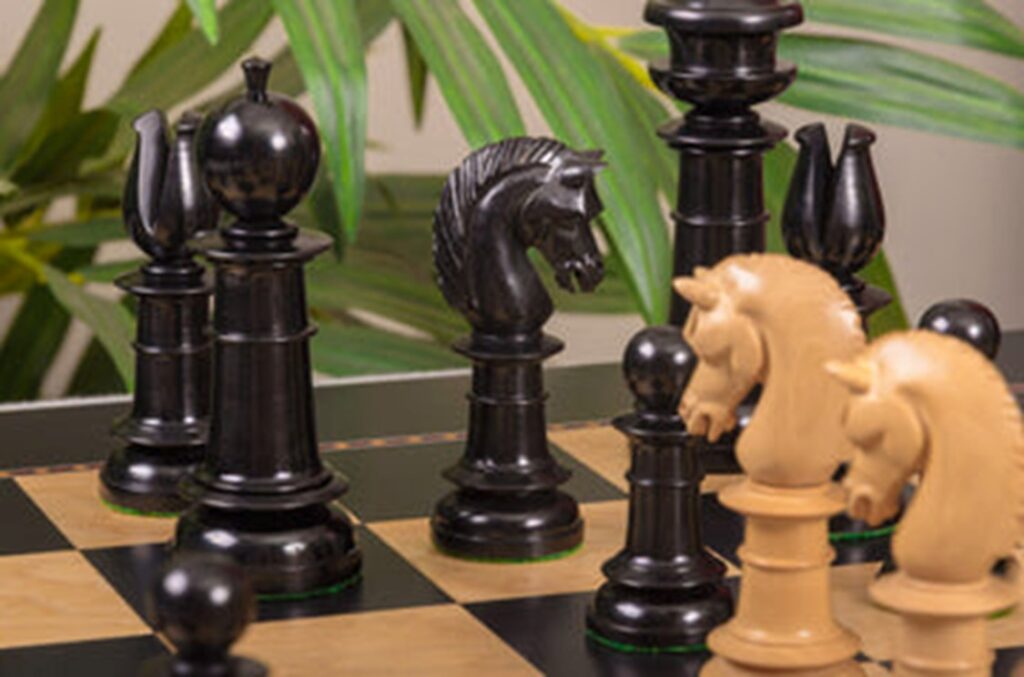
The Staunton chess set was revolutionary, designed for players and intended to provide the best experience across all kinds of play. Sets prior to the Staunton were ornate, decorative pieces played in a genteel manner. The Staunton dispensed with the elaborate small details that caused pieces to tip over and break. The simple, turned shapes are easier to produce and more stable, especially when weighted. There are few delicate pieces to break off. For a chess player who wanted to play often and with gusto, these pieces were just right and lasted a long time.


7. The Staunton Chess Set Helped Promote Chess

Image by eloiroudaire77 from Pixabay
One of the reasons so many of the original Staunton sets still exist today is how popular they became. Because of their ease of manufacture, the price was reasonable for a working-class household. The durability of the simple pieces meant they stood up to rough and spirited play at the coffeehouses and in “rougher” establishments. Another major advantage of the Staunton is that the pieces are universally recognizable. Anyone in the world can sit down at a Staunton set and play without confusion. The Staunton was truly a set for everyone.
8. Staunton Sets Belong in Famous Places
Chess has many historic matches people talk about and study long after they’re over. For some of the more famous matches, designers made a custom chess set to commemorate the occasion. One set we know well was designed for the Fischer v. Spassky World Championship match in 1972, held in Reykjavik, Iceland. A classic Staunton design with a sturdy, almost cheerful knight, it has been faithfully reproduced in the Reykjavik II Set. Interestingly, our own Frank Camaratta designed a special set for the ill-fated 2005 Fischer v. Karpov match in Iceland. While the match didn’t proceed, Fischer indicated through his intermediary that he approved of the set.
Clubs may have their own variation on the Staunton as well. The Mechanics Institute in San Francisco has their own version of the classic design with heavy weighting and chunky, sturdy knights. It was originally designed for a simul exhibition by Jose Raul Capablanca in 1916 at the club, and the last of the original sets was finally retired in the 1970s! Like many famous sets, a replica version of the Mechanics Institute set is available for players who love chess history and (possibly) need their pieces to take abuse.


A Clear Winner
If you have a contemporary chess set, odds are it’s based on the Staunton design in some way, if not a direct descendant. Scholastic chess and tournaments all around the world use durable plastic Staunton sets. Collectors hunt down rare antique sets and variations to enjoy and display as part of chess history. Serious chess players have luxury versions to admire while they’re in use. We hope you’ve learned something new about the chess set in your game room. Maybe we've inspired you to get your first Staunton set!