
All You Need To Know About “Chess Personality”
I don’t know my chess personality. I’d like to think of myself as daring, adventurous, and willing to play tactical positions like the great romantic players of the past. But in reality, I’m probably playing hope chess, and playing it slowly as I flag half my games. Think about your own play style. Do you find that you always play aggressively, lean on theory, or maybe sacrifice a little too often? And what other parts of your personality influence your chess?

What is a Chess Personality?
The idea of a chess player having certain tendencies, or a “personality,” has been around since the beginning of chess. Adolf Anderssen, the winner of the first international chess tournament held in London in 1851, is described even in this archived New York Times article from September 10, 1972, as “Anderssen, First Champion, Master of Combinative Play.” His “personality,” that he played combatively and tactically, was part of what led Anderssen to victories against other greats of his time.

The Library Imperial Collector Series Luxury Chess Pieces - 3.0" King

Luxe Premium Chess Box - Amboyna Burl

The House of Staunton DELUXE Tournament Bag
Personality, Skill, or Understanding the Game
At a certain level of chess, all good players need to have similar tendencies. They all need to be seriously talented at all aspects of the game. Each grandmaster must be a master of patience, a talented tactician, and a cut-throat endgame player. Not a single top player could afford to have a singular personality. But still, there are nuances. In the same way that top NBA players can still be distinguishable by their varying skills, or even top tennis players might have certain quirks that make them uniquely talented, grandmasters of chess can have their own chess personalities, just like you.
Real Applications for Chess Players
So, how does knowing your own chess personality benefit you? I would argue that, especially in blitz and bullet chess, or during the time crunches of a classical game, it is very important to know your own strengths and weaknesses. I, for instance, know that I tend to run out of time, overcalculating fun sacrifices and moves that ultimately I won’t play. Once I know that about myself, I can notice it during my games! Look within yourself, or seek help from a chess coach, and try to identify your tendencies on the chessboard. Where are you most commonly making mistakes? When do you tend to miss tactics? Do you find yourself out of prep quickly and wasting a lot of time in the opening? These are the types of questions that can help you identify your tendencies in chess, so that you can improve.
Chess.com’s Chess Personality Quiz
Okay, okay, but what about Chess.com’s quiz? Back in 2024, chess.com did what they do best, and played their other favorite board game, Monopoly. They gobbled up some other company that had made a chess personality quiz and repurposed it for themselves, adding chess personalities like GothamChess to the mix. According to the page, their scale is that every player exists on multiple sliding scales: intuition vs. calculation, attacking vs. positional, calm vs. emotional, and playful vs. studious. I think at least two of those scales are useful to think about when thinking of your own play.
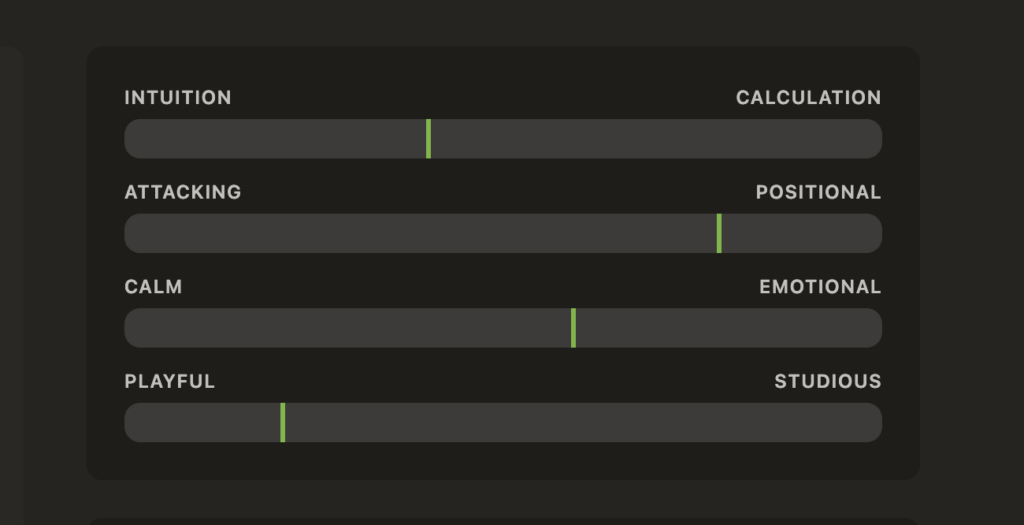
The stats for “The Wildcard” personality type.
Intuition vs. Calculation
I often describe blitz and bullet chess as tests of one's chess intuition. What kinds of moves are you learning to naturally select quickly because you are gaining a good intuition for the game? Comparatively, when you stop, slow down, and calculate, then you have time to see moves that you may have never seen in the split second that your intuition operated in. All great players have good intuition and good calculation skills, but there are definitely players who rely more heavily on blunt calculation than intuition.

The *NEW* Austrian Coffeehouse Series Chess Pieces - 4.0" King

Premium Chess Box - Golden Heart

The Large Ultimate Chess Bag
Computer Chess and Calculation
This is also a good distinguisher between humans playing chess and computers. Computers brute-force calculate everything, for the most part. At least the traditional, non-neural network type of chess computer. They find their move by just calculating all the moves. Humans, though, don’t have the time or mental capacity to calculate every single move in a position, so we rely on our intuition. You look at a position, and your past experience tells you which moves are likely good to focus on.
Attacking vs. Positional
This is another very valid way of looking at how we play chess. Almost every game I have played against a titled player casually has never been finished with wild sacrifices or insane tactics; they simply dominated the game positionally. I would lose by asphyxiation, as my position and chances of winning were slowly choked off. Does that mean that those players didn’t know how to play attacking chess? No! If anything, it meant that I didn’t know how to play good positional chess. On the other hand, the times I have felt any chance against much better players are when I was able to complicate the position and play fun, attacking chess, while still usually losing.

The Fischer Spassky Series Chess Pieces - 6.0" King

DOWNLOAD - CHESSBASE '26 - Premium Package

The Millennium King Competition Chess Computer
Calm vs. Emotional
This is where I start to lose some understanding on this quiz. Emotional? This still means attacking vs. positional. Top chess players may play with heightened competitiveness, or may occasionally have tense situations, but I don’t think top players necessarily play “emotionally.” One way that you do see emotions impact chess, is with lower-rated players. When a beginner or even intermediate player makes a mistake, they can sometimes fall into the trap of then making more mistakes. Blunders in chess often come in pairs. You make one mistake, and then you are already mentally prepared to make another and another. Positions fall apart when you don’t play calmly, even in the heated moments.
Romantic Chess
Now, if you want to categorize “emotional” chess as “romantic” chess, then I think that I, and even some grandmasters, can fall victim to this. Chess players are often drawn to the beauty of chess. Aiming for the beautiful line they saw in their head, instead of the simple, calm solution that is probably staring them in the face.
Playful vs. Studious
I’m not really sure what this is supposed to mean. I think it may be trying to integrate your approach in opening theory into your chess personality, but I think this is a bit of a false dichotomy. Regardless, apparently, it changes the results of your chess personality!
Should You Change How You Play Chess Matches?
Let’s say you take the personality quiz. Should you adjust your play based on the result? Not really. Learning about yourself, especially on the chessboard, is incredibly valuable, but mostly as a way to understand and interpret your intuitions and guide them more towards what we know to be solid chess. Your natural tendency might be to sacrifice pieces. It’s good to know that about yourself. Just because you are tempted to sac a piece, doesn’t mean you should! But if you never sac a piece, and you are tempted to do it, then that probably means the evidence is on the board begging you to play the move!

The Library Collection - The Anderssen Dropjaw Series Luxury Chess Pieces - 3'' King

Millennium eONE Electronic Chess Board for playing on chess.com
What Kind of People Like Chess
Before we look at the results of the chess personality quiz, I think it is interesting to examine the personalities drawn to chess. I have worked with and taught thousands of chess players, and many of them share common qualities. No matter their rating, they often become hyper-fixated on things, namely, chess. That ability to focus on the game means that they have come as far as they have. That can also mean that they are stubborn or set in their ways. Sometimes, chess players have a hard time adjusting their way of playing because they are very dedicated to how they think they should play the game. Chess players can also be very analytical people. It’s no surprise when top analytical minds in the world also happen to love chess.
How to Use Chess to Understand Yourself
I have actually learned a lot about my own personality through chess. I tend to flag and run out of time. That is paralysis by analysis! The inability to make decisions. Chess has taught me to look at the available options and pick the best one, even if you don’t know it is perfect. On the other hand, there are people who live lives where they don’t think about their decisions. Those people can learn the skill of calculation from chess. Take in the evidence you have and make an informed decision. Don’t just make a decision because you think you know the best answer right off the bat; think!
Chess as Decision-Making Practice
Chess has trained me and many others to make decisions. When I teach children and talk to parents, I always tell them that the benefit of learning chess is not just that they are learning a new, fun game, but that they are learning to think critically and make quick, well-informed decisions.

The Burnt Dubrovnik Series Chess Pieces - 3.75" King

DGT 2500 Digital Chess Clock

Premium Chess Box - Brazilian Rosewood
My Chess Personality
After taking the chess.com personality quiz, I learned that I am a romantic. Something I could have told you before taking the quiz. I will usually play moves that seem interesting and look the prettiest. The quiz gives Paul Morphy as an example of this kind of player, but I can only hope to have games like him. What about you?

Should You Care About Your Chess Personality?
Know yourself. Know your tendencies. I know that my inclination is to sacrifice a piece, so I have to force myself to calculate enough to talk myself out of those moves. You may tend to play more solid chess, and need to know that about yourself, and force yourself to calculate the sacrifice. We are all different, and understanding your chess personality is about understanding your chess tendencies. Once you do, then you can improve.