
Which Chess Books Should Every Player Have
If you have gotten into chess recently, you've probably also gotten into chess books. Chess players love to collect chess books, even if they don’t read them. But which chess books are best not only to own, but to actually read? When you are new to chess, the endless recommendations and chess books thrown at you can feel overwhelming. Use this list to make sure you get truly useful chess books to start your collection.

Beginner Chess Books
When you're starting your chess book collection, you'll likely want to fill it with beginner books. Beginner chess books can be incredibly useful even if you feel like you already know the basics. What should you consider when choosing a beginner chess book? There are many types, but the best ones provide a comprehensive understanding of the game and don’t just cover moves, tactics, and rules; they also offer guidance on how to improve. Here are some books I recommend adding to your chess collection, especially if you're a beginner or a self-taught player who hasn't mastered the fundamentals yet.
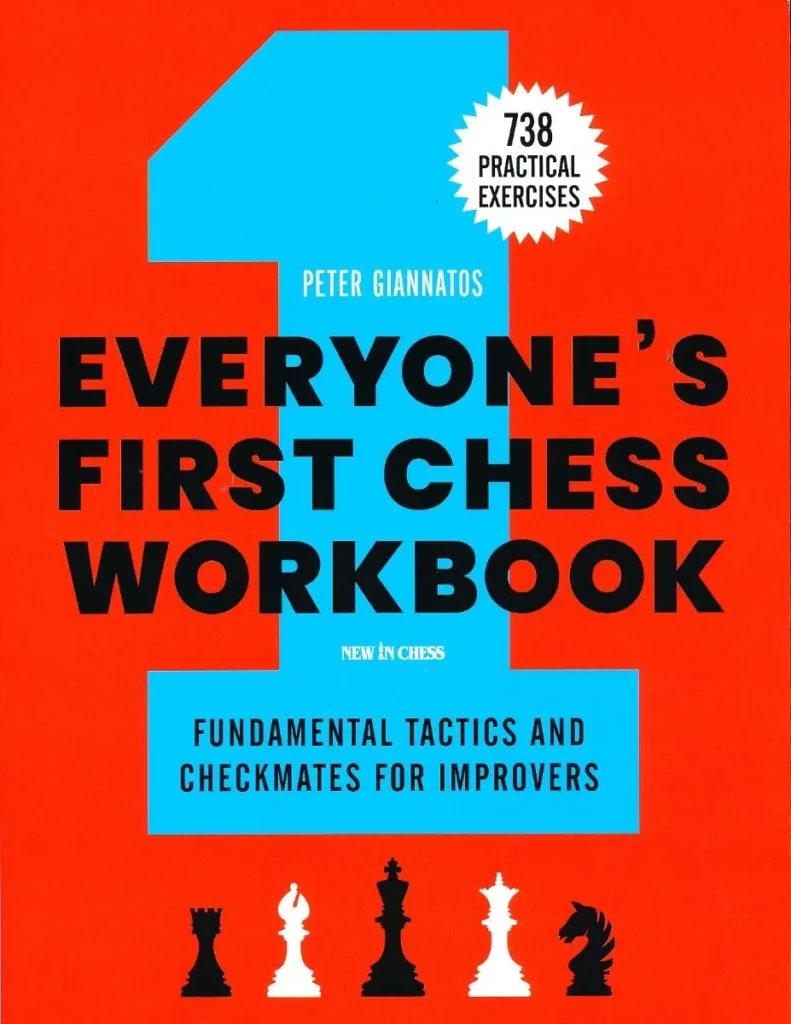
Everyone's First Chess Workbook
This excellent step-by-step chess workbook offers 738 exercises to practice notation and record moves. Author Peter Giannatos, with years of experience creating instructional positions, often uses this book to teach fundamental tactics. Even if you believe you're beyond this level, I recommend trying it to strengthen your chess foundation; maybe time yourself to see how quickly you can complete the puzzles. Most skilled players aiming for greatness must master and build upon their basic skills. If nothing else, this is a great book to keep on your shelf and give to new chess players in your life.

The Burnt Dubrovnik Series Chess Pieces - 3.75" King

DGT 2500 Digital Chess Clock

Premium Chess Box - Brazilian Rosewood
Chess Workbooks
A chess workbook is especially useful for kids as a hands-on approach to practicing tactics. These books help you get into a study mindset. If you're a parent, it’s a great way to participate in your child's chess development—have them solve the puzzles and then review their work. Usually, the answers are provided at the bottom of the page or in the back of the book, making it easy to verify. Ensure they are actively calculating and truly engaging with the puzzles.
Chess Tactics for Students
If you or that new chess player has completed Everyone’s First Chess Workbook, Chess Tactics for Students can be a valuable next step. Even if you're not a young learner, any chess enthusiast can benefit greatly from practicing these problems over and over. The book offers 253 pages with 434 carefully selected problems of increasing difficulty. Solving more puzzles is an excellent way to enhance your chess skills, so keep practicing! Repeating these patterns will help you recognize these tactics in your own games. A worthy tactics book for your chess bookshelf.
Learn to Play Chess Like a Boss
Learn to Play Chess Like a Boss was among the first chess books I read as a beginner. I started learning chess as an adult, and this book helped fill gaps in my understanding that I missed while teaching myself. It combines chess fundamentals, tactics, and insights into chess history. Patrick Wolff clearly explains what you need to learn to improve, guiding you from complete beginner to someone who can win chess games confidently. Similar to Everyone's First Chess Workbook, even if you're already familiar with the basics, this book will elevate your skills and strengthen your chess foundation. This book has a special place in my heart, but I believe it deserves a place in anyone's library.
Harder Tactics Chess Books
I’ve already recommended a few tactics books for beginners, but as an intermediate and advanced player, you also want to have chess tactics books on your shelf. Once you know the basics of chess, it is good to keep practicing with tactics puzzles. Usually, beginner chess books introduce basic tactics such as forks, pins, and skewers. Doing puzzles and using tactics books is one of the best ways to get better at the game of chess. While there are plenty of great ways to do chess puzzles online, puzzle books are delightful in their own way and can be a nice addition to your collection.

1001 Chess Exercises For Club Players
If you can complete 1001 Chess Exercises For Club Players, you will be a true tactics savant. They are not easy, but doing this many will prepare you for high-level play. I recommend giving this book a shot, especially if other beginner books are too easy for you.

The Collector Series Luxury Chess Pieces - 4.0" King

The Camaratta Signature Master Chess Table

LIMITED EDITION - DGT 3000 Digital Chess Clock
Classic Chess Books
The great part about collecting chess books is that there are thousands of great old chess books that you can dig through and collect. Most bookstores will have a book or two in their games section, and you might stumble across a classic. As you grow your collection, you will find yourself adding a few chess books simply because they are classics. Most of the time, they are classics for a reason! Bobby Fischer Teaches Chess, for instance, is a solid book for learning the basics of chess, and others stand the test of time as well.
Bobby Fischer Teaches Chess
Bobby Fischer Teaches Chess is possibly the most popular chess book of all time. For many, especially those from older generations, this was their first exposure to a chess book. Published in 1966 and authored by Bobby Fischer, with Stuart Margulies and Donn Mosenfelder as co-authors, it has sold over a million copies, making it widely accessible. The book features nineteen examples taken from real games played by Fischer. As we will discuss shortly, analyzing master games is an excellent way to improve at chess, offering valuable insights through exploring actual game positions. While I wouldn't recommend it as your only introduction to chess, it remains an important piece of chess history. Most collections would be incomplete without one (and probably two or three) copies of this classic.
Annotated Game Collections
As you improve at chess, you'll outgrow basic books and start exploring strategy, endgames, and beyond. A key part of becoming a strong club-level player is learning how to analyze master games. Almost every grandmaster will tell you that the best way to go to the next level is to study annotated master games. By studying what the best players play, you can train yourself to react like a master. The easiest way to study master games is to get a book that has collected them for you.
The Mammoth Book of the World's Greatest Chess Games
The Mammoth Book of the World's Greatest Chess Games is a treasure trove of great positions, featuring 125 handpicked games. Each game is paired with valuable context and analysis, offering a richer understanding of the moves. True to its name, this book is massive! You'll need ample time to study these games, especially if you simulate them on a board, which is an excellent method to enhance your skills.

The Sovereign Series Chess Pieces - 4.0" King
Premium Chess Box - Brazilian Rosewood

The House of Staunton PROFESSIONAL Tournament Bag
The Immortal Games of Capablanca
Take a book like The Immortal Games of Capablanca, for instance. I love diving into one player and seeing how their style runs through their career. It lets you follow through Capablanca’s career and see his powers on the board. If you can pick up a copy, I recommend it to everyone. Instead of recommending a ton of other game collections, I recommend picking a player that you love from chess history, and finding a book that covers their games and learning from them.
Chess Strategy Books
Once you've conquered basic tactics, it's a great time to explore chess strategy. While tactics involve short-term move sequences that lead to advantageous positions, strategy focuses on long-term objectives. Effective strategies exist for every phase of the game. For example, you likely already know essential opening principles like developing your pieces, controlling the center, and castling. Strategy books are common because many chess players have opinions on good chess strategies! Try to pick one book and dive into what it means to play good strategy.

Winning Chess Strategies
This might be my favorite chess book. The book delivers exactly what it promises: complex strategies in easy-to-digest chapters. If you've put in the effort to master basic tactics and patterns from books like Everyone's First Chess Workbook and Learn to Play Chess Like a Boss, you'll be ready to move on to the strategy found in this book. Once your foundation is strong, good strategy becomes the structure you build upon that base. This book addresses questions like where to place your pieces and how to approach middle games, and more. Yasser covers strategy expertly, and this book is a great next step in your chess journey.

How to Reassess Your Chess
How to Reassess Your Chess will elevate your understanding of the game. This book is essential for any intermediate chess player's collection. This book expands on Silman’s well-known concept of imbalances, making it a must-have guide for players rated 1400 to 2100. I have also used it as a chess teacher. It carefully examines the basics of imbalances, helping readers build a solid grasp of each idea. I highly recommend any book by Jeremy Silman. All his works are excellent for learning, as he explains complex chess strategies in a way that is accessible to the average player.

The Modern Series Chess Pieces - 3.75" King

DGT Pegasus Chess Board (e-Board) - Wireless Bluetooth with USB Charger

Bobby Fischer Teaches Chess
Endgame Technique Books
Learning endgames is tough. Studying them and the strategies involved is necessary if you want to improve at chess. Several renowned endgame books can help you master both the strategic principles and the technical details of various endgame positions. Keep in mind that studying endgames can be demanding, lengthy, and exhausting, so be ready!
Dvoretsky's Endgame Manual
Dvoretsky's Endgame Manual is an excellent yet intricate resource for chess players aiming to master challenging endgames. Most grandmasters cite this book when discussing endgame study and improvement. However, it is a difficult read. Definitely add it to your collection.
Silman’s Complete Endgame Course
As you can see, I love Jeremy Silman’s works. Jeremy Silman, co-author of Winning Chess Strategies, has authored one of the most comprehensive endgame books, offering valuable insights for players of all levels. While beginners might not need to read the entire book immediately, Silman’s Complete Endgame Course is a great way to build a solid foundation in endgame basics. Depending on your experience, you might start with only the first few chapters, but the remaining sections will be available as you advance. Even the initial chapters give you a real edge, helping you handle basic endgames with more clarity and confidence. As you develop into an intermediate player, you can explore more of the book to deepen your understanding of endgames.